Wednesday, March 5, 2008

Piza's tower


The Leaning Tower of Pisa (Italian: Torre pendente di Pisa) or simply The Tower of Pisa (La Torre di Pisa) is the campanile, or freestanding bell tower, of the cathedral of the Italian city of Pisa. It is situated behind the Cathedral and it is the third structure by time in Pisa's Piazza del Duomo (Cathedral Square).

Although intended to stand vertically, the tower began leaning to the southeast soon after the onset of construction in 1173 due to a poorly laid foundation and loose substrate that has allowed the foundation to shift direction.

The height of the tower is 55.86 m (183.27 ft) from the ground on the lowest side and 56.70 m (186.02 ft) on the highest side. The width of the walls at the base is 4.09 m (13.42 ft) and at the top 2.48 m (8.14 ft). Its weight is estimated at 14,500 tonnes. The tower has 296 steps (the seventh floor has a different number of steps on the two sides, if you climb it on the north part you can count only 294 steps). The tower leans at an angle of 3.97 degrees[1]. This means that the top of the tower is 3.9 meters from where it would stand if the tower were perfectly vertical.[2]

Eiffel's tower


The Eiffel Tower (French: Tour Eiffel, /tuʀ ɛfɛl/) is an iron tower built on the Champ de Mars beside the Seine River in Paris. The tower has become a global icon of France and is one of the most recognizable structures in the world.

Rafik bahaeddine al-hariri


Rafik Bahaeddine Al-Hariri — (November 1, 1944 – February 14, 2005), (Arabic: رفيق بهاءالدين الحريري‎) a self-made billionaire and business tycoon, was Prime Minister of Lebanon from 1992 to 1998 and again from 2000 until his resignation, 20 October 2004. He headed five cabinets during his tenure. Hariri dominated the country's post-war political and business life and is widely credited with getting the country back on its feet after the devastating 15-year civil war.

Hariri was assassinated on 14 February 2005 when explosives equivalent to around 1000 kg of TNT were detonated as his motorcade drove past the St. George Hotel in the Lebanese capital, Beirut. The investigation into his assassination is still ongoing and it is conducted under the supervision of the United Nations and led by the independent investigator Serge Brammertz. It has been widely speculated that the Syrian government is linked to the assassination.[1]

Hariri's killing led to massive political change in Lebanon, including the Cedar Revolution and the withdrawal of Syrian troops from Lebanon.


Tuesday, March 4, 2008

Gibran khalil gibran bin mikhael bin saad


Khalil Gibran (full name Gibran Khalil Gibran bin Mikhael bin Saâd, Arabic: جبران خليل جبران بن ميخائيل بن سعد, Syriac: ܟ݂ܠܝܠ ܔܒܪܢ) (January 6, 1883 – April 10, 1931) was a Lebanese American artist, poet and writer. He was born in Lebanon (at the time the Mount Lebanon Province of the Ottoman Empire) and spent most of his life in the United States. He is the third bestselling poet in history after Shakespeare and Lao Tse. [1]

Salah al-din yusuf ibn ayyub


Saladin, properly known as Salah al-Dīn Yusuf ibn Ayyub (Arabic: صلاح الدين يوسف ابن أيوب‎, Kurdish: Selah'edînê Eyubî or سه‌لاحه‌دین ئه‌یوبی, Turkish: Selahaddin Eyyubi), (c. 1138 – March 4, 1193),[1] Sultan of Egypt and Syria, was a 12th-century Kurdish[2][3] Muslim political and military leader from Tikrit, Iraq. At the height of his power the Ayyubid dynasty, which he founded, ruled over Egypt, Syria, Iraq, Hejaz, and Yemen. He is best-known for leading the Muslim armies during the Crusades and recapturing Jerusalem.

William shakspeare


William Shakespeare (baptised 26 April 1564 – 23 April 1616)[a] was an English poet and playwright, widely regarded as the greatest writer in the English language and the world's pre-eminent dramatist.[1] He is often called England's national poet and the "Bard of Avon" (or simply "The Bard"). His surviving works consist of 38 plays,[b] 154 sonnets, two long narrative poems, and several other poems. His plays have been translated into every major living language and are performed more often than those of any other playwright.[2]

Shakespeare was born and raised in Stratford-upon-Avon. At the age of 18 he married Anne Hathaway, who bore him three children: Susanna, and twins Hamnet and Judith. Between 1585 and 1592 he began a successful career in London as an actor, writer, and part owner of the playing company the Lord Chamberlain's Men, later known as the King's Men. He appears to have retired to Stratford around 1613, where he died three years later. Few records of Shakespeare's private life survive, and there has been considerable speculation about such matters as his sexuality, religious beliefs, and whether the works attributed to him were written by others.[3]

Shakespeare produced most of his known work between 1590 and 1613. His early plays were mainly comedies and histories, genres he raised to the peak of sophistication and artistry by the end of the sixteenth century. Next he wrote mainly tragedies until about 1608, including Hamlet, King Lear, and Macbeth, considered some of the finest examples in the English language. In his last phase, he wrote tragicomedies and collaborated with other playwrights. Many of his plays were published in editions of varying quality and accuracy during his lifetime, and in 1623, two of his former theatrical colleagues published the First Folio, a collected edition of his dramatic works that included all but two of the plays now recognised as Shakespeare's.

Shakespeare was a respected poet and playwright in his own day, but his reputation did not rise to its present heights until the nineteenth century. The Romantics, in particular, acclaimed Shakespeare's genius, and the Victorians hero-worshipped Shakespeare with a reverence that George Bernard Shaw called "bardolatry".[4] In the twentieth century, his work was repeatedly adopted and rediscovered by new movements in scholarship and performance. His plays remain highly popular today and are consistently performed and reinterpreted in diverse cultural and political contexts throughout the world.

Neil alden armestrong


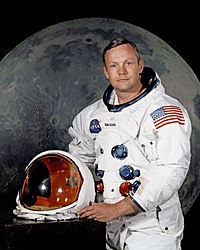
Neil Alden Armstrong (born August 5, 1930) is a former American astronaut, test pilot, university professor, and naval aviator. He was the first person to set foot on the Moon. His first spaceflight was aboard Gemini 8 in 1966, for which he was the command pilot. On this mission, he performed the first manned docking of two spacecraft together with pilot David Scott. Armstrong's second and last spaceflight was as mission commander of the Apollo 11 moon landing mission on July 20, 1969. On this famous "giant leap for mankind", Armstrong and Buzz Aldrin descended to the lunar surface ("The Eagle has landed") and spent 2.5 hours exploring while Michael Collins orbited above.

Before becoming an astronaut, Armstrong was in the USN and saw action in the Korean War. After the war, he served as a test pilot at the National Advisory Committee for Aeronautics (NACA) High-Speed Flight Station, now known as the Dryden Flight Research Center, where he flew over 900 flights in a variety of aircrafts. As a research pilot, Armstrong served as project pilot on the F-100 Super Sabre A and C aircraft, F-101 Voodoo, and the Lockheed F-104A Starfighter. He also flew the Bell X-1B, Bell X-5, North American X-15, F-105 Thunderchief, F-106 Delta Dart, B-47 Stratojet, KC-135 Stratotanker and Paresev. He graduated from Purdue University.